
Chester County Criminal Court Records
A Chester County criminal court record is the official court case record for a prosecution. In Common Pleas, the Clerk of Courts maintains criminal filings, docket records, sentencing orders, appeals, certified copies, and criminal financial obligations. Magisterial District Courts handle the early and lower-level record for summary offenses, traffic-related criminal matters, preliminary arraignments, preliminary hearings, and misdemeanor or felony cases before they move to Common Pleas.
The case file is broader than a charge list. It can include the criminal complaint, information, docket entries, motions, bail entries, hearing notices, pleas, verdicts, dispositions, sentencing orders, probation conditions, costs, restitution, and appeal activity. For a closer look at the charge itself, including amended or dismissed counts, use the Chester County arrest records and court charges page.
Clerk of Courts
201 W. Market St., Suite 1400
West Chester, PA 19380
610-344-6135
Monday-Friday 8:30 a.m.-4:30 p.m.
Search Chester County Criminal Court Records
Most public criminal docket searches begin at Pennsylvania UJS Case Search. Search by participant name, docket number, OTN, complaint number, police incident number, attorney, or date-based criteria when the portal offers that option. Select Chester County and the correct court type. Common Pleas records show higher criminal case activity, while Magisterial District Court records can show summary matters and preliminary criminal events.
- Open UJS Case Search and choose a criminal search path, such as participant name, docket number, OTN, complaint number, or police incident number.
- Filter by Chester County and select Common Pleas or Magisterial District Court when the search form asks for court type.
- Open the matching docket and review defendant name, OTN, charges, case status, bail, hearing events, and disposition entries.
- Use the docket number and court office listed on the sheet when requesting certified copies from the Clerk of Courts or an MDJ office.
- Use PAePay for many criminal balances, costs, fines, restitution, and payment-plan searches when the case is payable online.
Public docket access is not the same as statewide criminal-history access. Pennsylvania's Criminal History Record Information Act controls dissemination and use of criminal-history record information beyond ordinary court docket review.
The Criminal History Record Information Act image assigned to this page connects court-record access with Pennsylvania criminal-history rules.
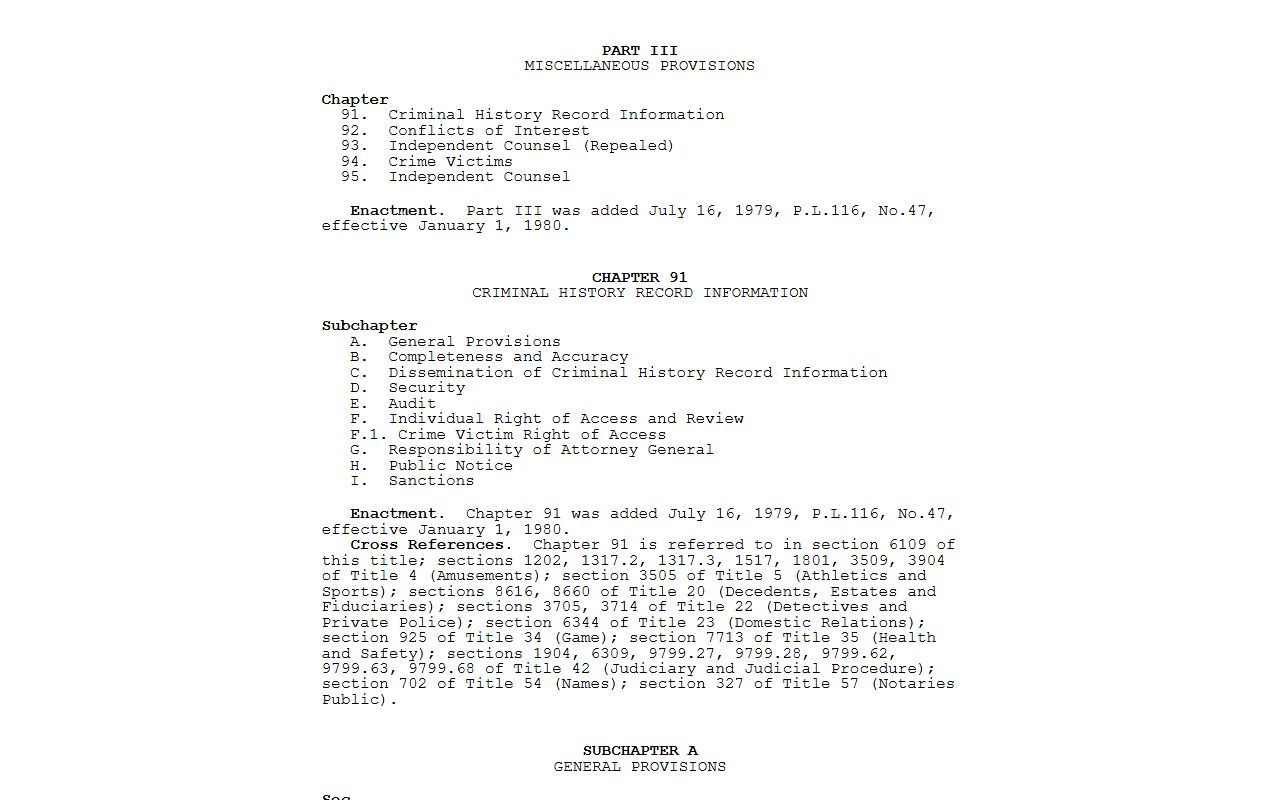
That statute matters when a criminal court record is used beyond ordinary docket research.
Chester County Criminal Case Flow
A Chester County criminal court record changes as the case moves from lower-court proceedings to Common Pleas. A case may begin with an arrest, complaint, citation, or preliminary arraignment. Magisterial District Court may handle the preliminary hearing and bind charges over. The Common Pleas case then proceeds through arraignment, pretrial filings, plea negotiations, trial, disposition, and sentencing when charges remain.
Case flow: Charges Filed › Preliminary Arraignment or Hearing › Common Pleas Arraignment › Pretrial and Motions › Plea or Trial › Disposition › Sentencing
| Stage | What Happens |
|---|---|
| Charges filed | A complaint or charging document creates the court record and may assign an OTN or complaint number. |
| Preliminary proceedings | An MDJ may address bail, preliminary arraignment, and whether charges move forward. |
| Common Pleas arraignment | The defendant is formally brought into the trial-level case and future deadlines are set. |
| Pretrial and motions | Attorneys file requests, discovery issues arise, and hearings or continuances may appear as entries. |
| Plea or trial | The case resolves by plea, verdict, dismissal, acquittal, or another disposition. |
| Sentencing | The court records confinement, probation, fines, costs, restitution, or other sentence terms when imposed. |
What Chester County Criminal Records Show
Criminal court records in Chester County should be read as case-level records. A charge line can look serious but later be reduced, withdrawn, dismissed, or resolved differently at sentencing. A docket can also show bail events, bench warrants, probation violations, appeal filings, payment activity, and sentence modifications. Look for the final disposition for each count, not just the first filed charge.
| Field | What It Shows |
|---|---|
| Docket number | The Common Pleas or MDJ case identifier used by the court and clerk. |
| Defendant | The person charged, with identifying details limited by public access rules. |
| OTN | Pennsylvania offense tracking number used in criminal records. |
| Arresting agency | The law-enforcement agency listed on the criminal docket when public. |
| Charges | Statute citation, count, grading, offense date, and status for each alleged offense. |
| Bail | Bail type, conditions, forfeiture, bench warrant, or related release entries when public. |
| Plea and disposition | How each count resolved, such as guilty, not guilty, dismissed, withdrawn, or nolle prosequi. |
| Sentence | Confinement, probation, costs, fines, restitution, and supervision entries when imposed. |
Charges vs Convictions
A charge is an accusation filed in court. A conviction is a result after a guilty plea, verdict, or other qualifying disposition. Chester County criminal court records can show both, so the wording beside each charge matters. A record may list several charges from one incident, with only some ending in conviction. Other counts may be amended, dismissed, withdrawn, or resolved through a plea agreement.
| Point | Charge | Conviction |
|---|---|---|
| Meaning | An accusation filed by law enforcement or the prosecutor. | A final finding or plea that establishes guilt for a count. |
| Timing | Appears early and may change as the case moves. | Appears after plea, verdict, or final disposition. |
| Record risk | May remain visible unless sealed, expunged, or limited by law. | May affect sentence, costs, probation, custody, and criminal-history reporting. |
Sealed and Expunged Criminal Records
Chester County criminal court records may be restricted after a court order or statutory process. Pennsylvania uses expungement and limited access. Expungement under 18 Pa.C.S. 9122 is a stronger remedy that removes qualifying records from public access. Limited access under 18 Pa.C.S. 9122.1 restricts public access to some criminal-history information while preserving access for criminal-justice agencies.
| Point | Sealed or Limited Access | Expunged |
|---|---|---|
| Public visibility | Hidden or restricted from ordinary public searches. | Removed from public access after qualifying order and processing. |
| Agency access | Criminal-justice agencies may retain access. | Very limited access may remain as allowed by law. |
| Typical path | Eligibility check, petition or automated process where applicable, and court or statutory restriction. | Eligibility check, petition in the court that handled the case, service, and order. |
The expungement statute image assigned to this page supports the public-access limits that apply after qualifying relief.
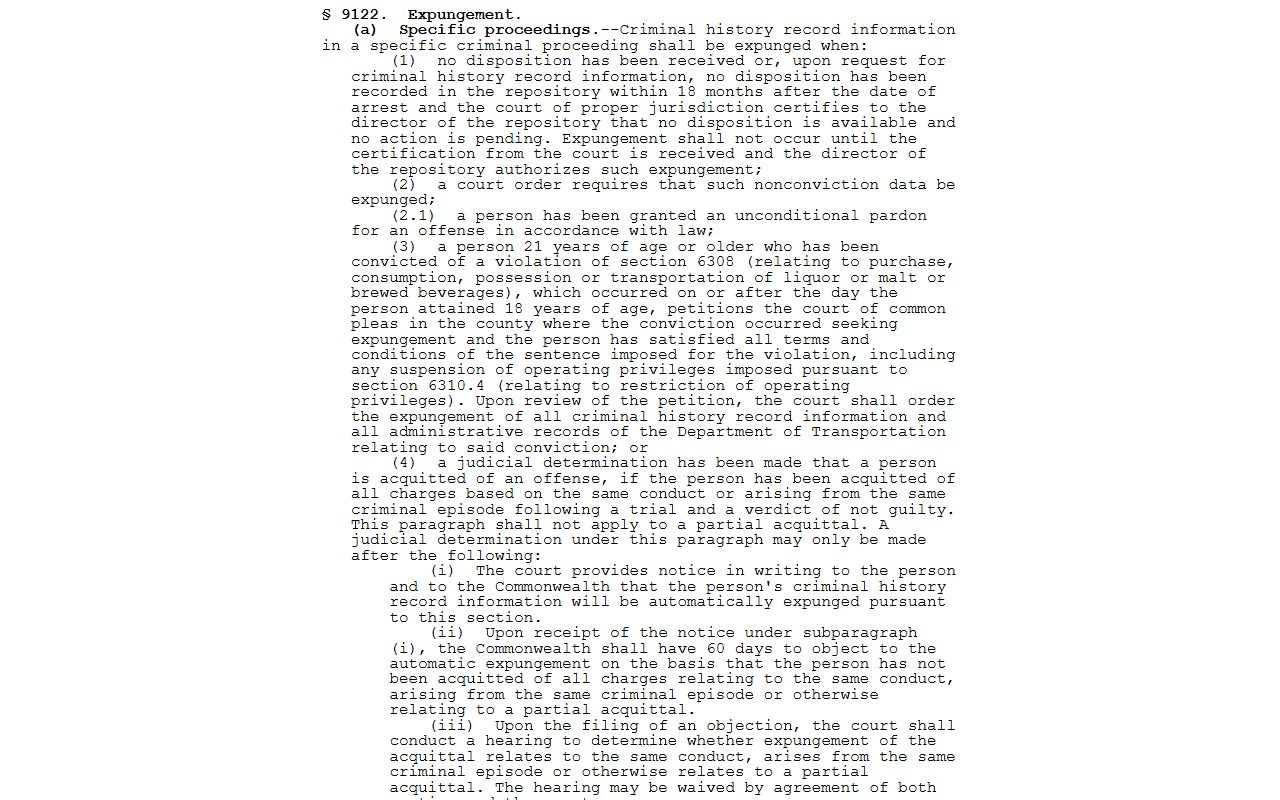
Expungement is case-specific, so the docket, charge status, and final disposition must be reviewed before assuming eligibility.
Public Access to Chester County Criminal Records
Public access to Chester County criminal court records is shaped by court policy, criminal-history law, and case-specific restrictions. UJS docket sheets are the practical first stop. The Clerk of Courts is the local office for Common Pleas criminal certified copies, sentencing orders, appeals, and criminal payment questions. County Right-to-Know requests are for administrative records, not a substitute for court case access rules.
Key access rules: Pennsylvania judiciary public-record policies govern UJS records, while Chapter 91 controls criminal-history dissemination and use.
Juvenile records, sealed records, expunged records, protected victim details, protected addresses, mental-health material, and certain family-related information are restricted or redacted. If a public criminal docket has vanished after a court order, the next step is not a broader web search. It is review of the court order, attorney authority, or the office procedure that controls access.
The limited access statute image assigned to Chester County criminal court records marks the second major Pennsylvania restriction path.
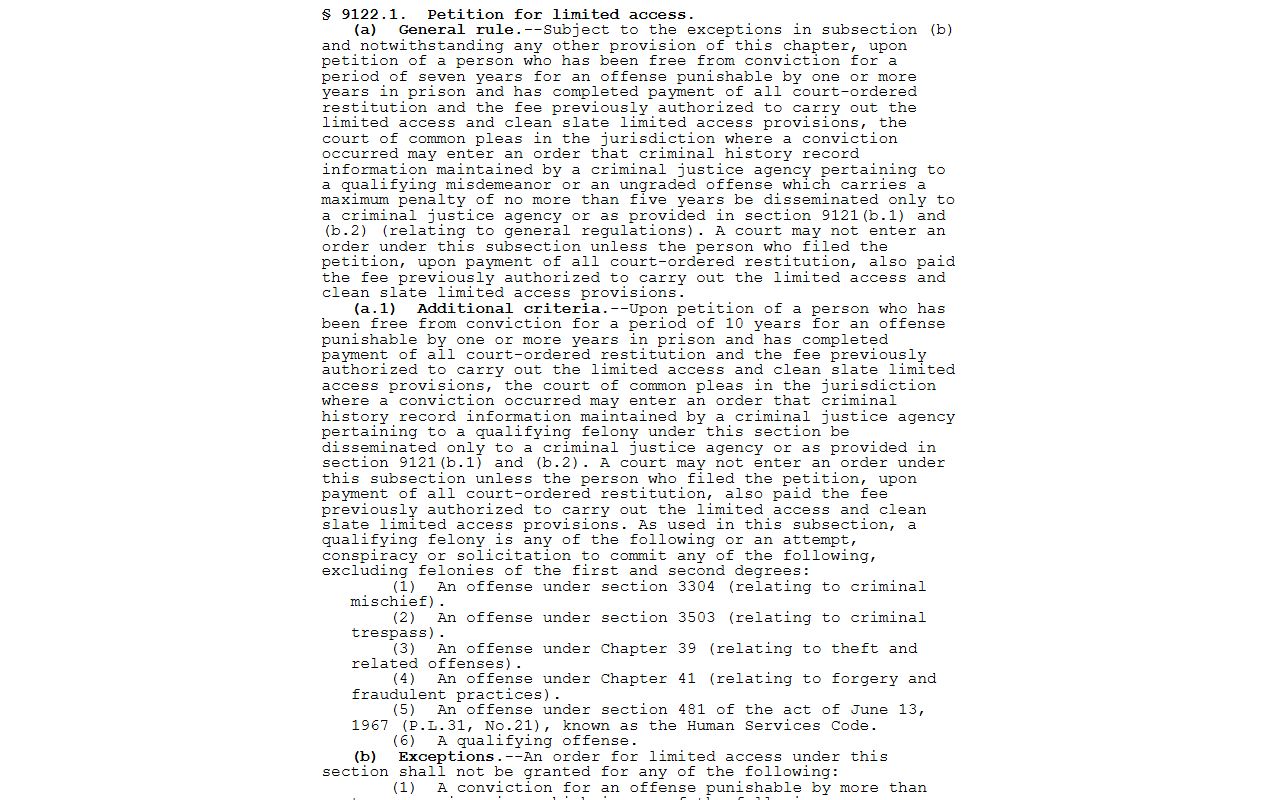
Limited access can change what the public sees even though courts and criminal-justice agencies may retain permitted access.
DA and Defense Record Paths
The Chester County District Attorney prosecutes Commonwealth criminal cases, works with law enforcement, supports victims and witnesses, and handles trial, juvenile, appellate, and specialty prosecution functions as assigned by the office. The Public Defender represents financially eligible defendants in criminal, juvenile, and related matters where counsel is constitutionally required. Neither office replaces the Clerk of Courts as the criminal record custodian, but both may appear throughout the case history.
Users should not treat a docket search as legal advice. Docket data can help identify charges, counsel, hearing dates, bail entries, and case status. Decisions about warrants, pleas, expungement, limited access, sentencing, or probation should be handled through counsel, the issuing court, or the appropriate public office.